

3 min read
Imagine a shopper opens ChatGPT and types something like, "Find me the best waterproof hiking boot under $200, available in a size 11." Within seconds, the tool surfaces three options complete with specs, pricing, and a link to buy. Your brand sells exactly that boot, but it doesn't appear in the recommendations. Why?
No one on your team did anything wrong—the product is in stock, the price is right, and the storefront looks great. The problem is that the AI couldn't read your product data well enough to include you in the conversation, so for that shopper, in that moment, you simply didn't exist.
This is the reality of AI commerce, and it's already here. As AI becomes the primary interface through which shoppers discover, compare, and evaluate products, the quality and structure of your product data is quickly becoming your most important growth lever.
The Front Door to Commerce Has Moved
For the past two decades, winning at eCommerce meant showing up on Google, investing in your storefront experience, and optimizing for the human shopper clicking through search results. That model is shifting faster than most teams have had time to process.
That’s because agentic commerce stepped onto the scene. Agentic commerce is a model of online shopping where AI agents research, compare, and select products on behalf of the shopper, handling the entire discovery and evaluation process with minimal human input. Rather than a person typing a query into Google and clicking through a list of results, the AI is doing the legwork: interpreting intent, reviewing available product data across merchant catalogs, and surfacing the options it deems most relevant.
Shopify—whose merchant ecosystem spans millions of brands across 175 countries—recently declared that AI is “the new front door to commerce,” and is building its entire infrastructure around that bet. Shopify’s Agentic Storefronts product now connects merchants directly to ChatGPT, Microsoft Copilot, and Google AI Mode, meaning products from its catalog are being surfaced inside AI conversations hundreds of millions of times a day.
McKinsey estimates the global agentic commerce opportunity could reach $3 to $5 trillion by 2030, and AI-driven traffic to Shopify stores alone has already grown 7x since January 2025. The channel is real, it is scaling, and the brands that show up there won’t necessarily be the ones with the biggest ad budgets, but the ones with the cleanest product data.

How AI Discovers Products (Nothing Like How Humans Do)
When a human lands on your storefront, they bring context. They scroll, they squint at an image, they infer that "charcoal" probably means dark grey, and they forgive a missing spec or two because the product looks right. But AI agents do none of that. AI agents parse structured data, match explicit attributes against a shopper's intent, and make inclusion decisions in mere milliseconds, with no patience for missing information and no ability to fill in the gaps.
When a shopper asks an AI agent to find a product, the agent isn't browsing your website. It's reading your catalog data the same way a machine reads code—looking for normalized attributes, consistent taxonomy, clearly defined variants, and accurate pricing. If those signals are present and legible, your product is a candidate. If they are missing, inconsistent, or structured in a way the system can't interpret, your product is excluded.
This is the fundamental shift that most eCommerce teams have not yet internalized. AI product discovery is not a faster or smarter version of SEO keyword search, but rather an entirely different mechanism that rewards data structure above almost everything else.
The Gap Between Your Product Data and What AI Commerce Requires
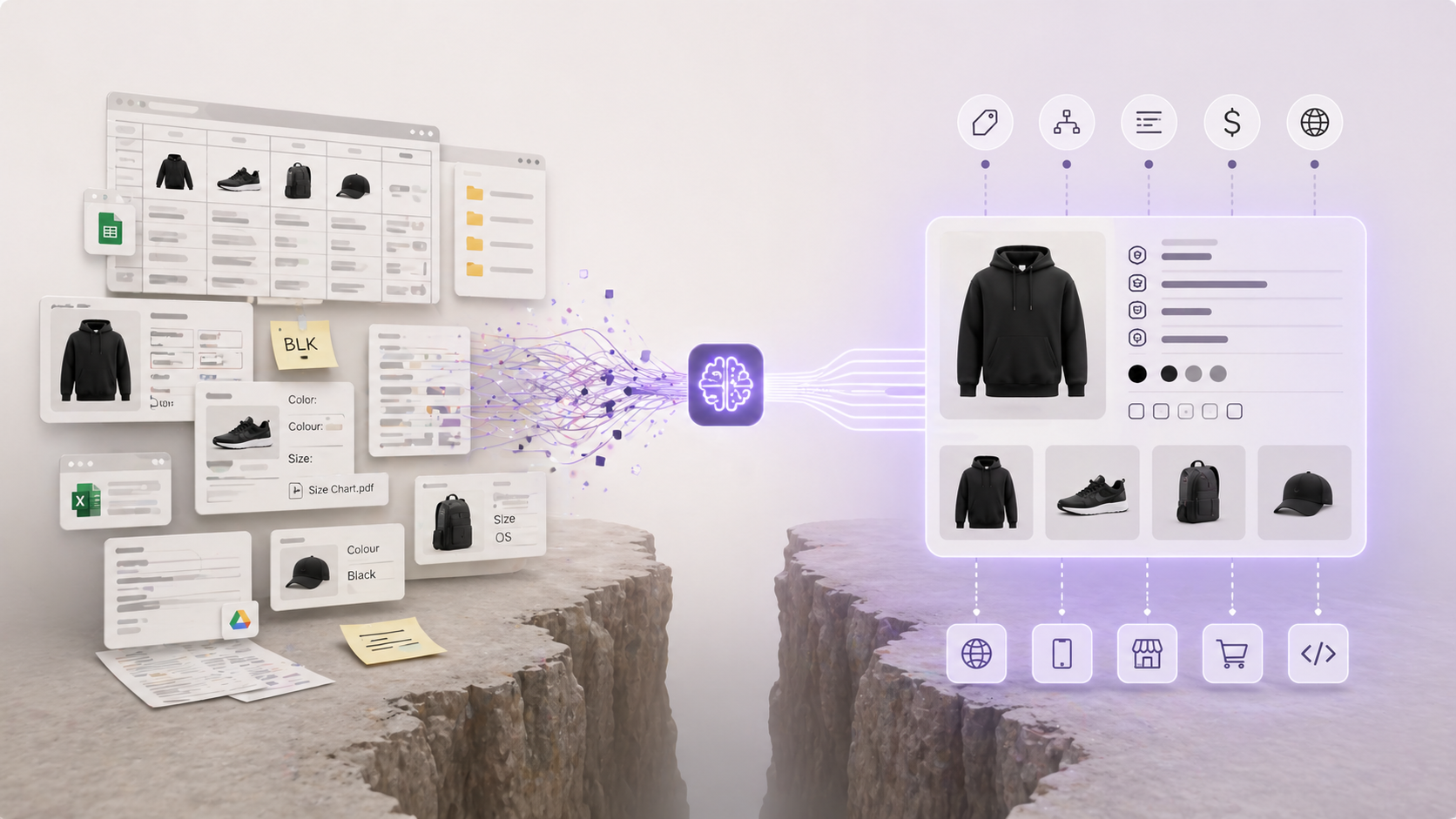
eCommerce product data was built for people—merchandising teams who knew that "BLK" meant black, or that the size chart lived in a separate PDF, or that the Canadian storefront had slightly different specs.
AI agents have no access to that contextual knowledge. They need product data that is explicit, normalized, and consistent across every channel and locale, because that is the only format they can reliably act on. Specifically, AI-driven product discovery depends on things like:
- Standardized attribute naming (not "color" and "colour" living in two different fields)
- Clearly defined parent-child variant relationships
- Complete and channel-appropriate descriptions
- Pricing that is accurate and current across every endpoint
For most growing brands—particularly those managing hundreds or thousands of SKUs across Shopify, marketplaces, and regional storefronts—that level of data consistency is difficult to maintain without a centralized system purpose-built for it. Spreadsheets and shared drives got you here, but they are not designed to produce the kind of machine-readable, structured product data that agentic commerce requires. The gap between where most catalogs are today and where they need to be is widening as AI commerce continues to grow.
Don’t Let Product Data Accuracy Become a Revenue Problem
For most eCommerce teams, product data quality has traditionally lived in the operations function. After all, it matters for internal efficiency, reduces returns, and keeps the merchandising team from losing their minds. But that framing undersells the problem significantly in an agentic AI commerce environment.
When AI agents are the ones deciding which products get surfaced to a high-intent shopper, data structure is no longer just an operational concern, but a revenue problem.
A product with incomplete attributes, inconsistent variant data, or channel-specific discrepancies is harder for AI systems to recommend with confidence, which means it is less likely to appear in AI search results at all. As agentic commerce scales across platforms like ChatGPT, Google AI Mode, and Microsoft Copilot, the brands investing in structured, accurate, and centralized product data with proper Product Information Management (PIM) systems will have an advantage over those still reconciling spreadsheets.
The good news is that this is a solvable problem. The question worth asking your team today is simple: If an AI agent parsed our product catalog right now, how many of our products would make the cut?
If you’d like to find out, run your Shopify export through our agentic readiness tool and see if your catalog is AI-ready.