

6 min read
Anyone who has waited five business days for a refund, an insurance cheque, or a freelance payment knows the frustration: the money feels like it should already be there. When a message can cross the country in seconds, waiting a week for a payment feels out of step.
That disconnect is becoming a business problem. Instant payment used to feel like a premium feature; now, people increasingly expect it. When businesses make customers wait, the cost can show up in support calls, weaker loyalty, and customers choosing another option.
Why this matters now
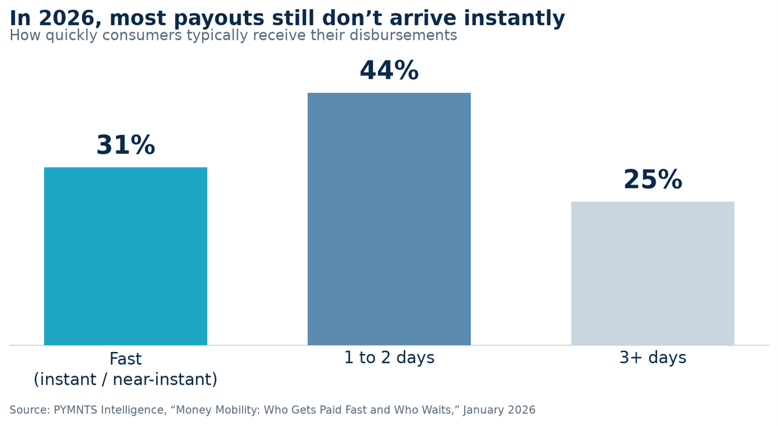
The change is already underway, but there is still plenty of room to improve. In early 2026, only about three in 10 payouts arrived instantly or near-instantly, while one in four still took three days or longer. When a faster option is available, people tend to use it, whether they are receiving wages, gig income, refunds, winnings, or insurance payments. Among people who rely on disbursements as a key source of income, nearly four in 10 choose to receive their money within a day.
For companies weighing instant payouts in Canada, the timing has an extra layer. The Real-Time Rail (RTR), Canada’s new always-on instant payment system is set to launch in the fourth quarter of 2026, with its governing by-law and rules coming into force on August 24, 2026. It will be a genuine milestone.
The important point is that businesses do not need to wait for the RTR to offer faster payouts. Push-to-card services such as Visa Direct and Mastercard Send can already send funds to a customer's card in seconds to about a minute, at any time of day. In other words, much of the infrastructure needed for instant refunds and disbursements is already sitting in customers' wallets.
49%of Canadians find real-time payments appealing |
36%would switch to real-time payments from their current method |
60%of instant insurance payouts are delivered via push-to-card, the top rail |
Sources: Payments Canada, 2026; PYMNTS Intelligence Money Mobility Tracker, 2026.
Where instant payouts fit in your disbursement stack
Many Canadian businesses already rely on two main payout methods: EFT for scheduled, high-volume payments such as payroll and supplier runs, and Interac e-Transfer for one-off consumer payments. Push-to-card adds another option, one that is designed for situations where speed genuinely changes the experience.
It is less about replacing a familiar payment method and more about choosing the right one for each situation. A weekly supplier payment may not need to arrive in ten seconds. A refund for an unhappy customer, or a gig worker's earnings after a shift, often does.
Push-to-card 101: how Visa Direct and Mastercard Send work
A regular card purchase pulls money from a card at checkout. Push-to-card works in the other direction: it sends money to the card. The recipient provides a card number instead of bank routing and account details, and funds typically arrive within seconds or about a minute, 24/7.
The scale is significant. Visa Direct processed 12.6 billion money-movement transactions in its most recent full fiscal year, and Visa again identified money movement as a major growth area in its second-quarter 2026 results. Mastercard's network reaches close to 10 billion endpoints in 180 countries and more than 150 currencies. The capability is already available in Canada, supporting near-instant payments to eligible debit and prepaid cards for uses such as refunds and gaming disbursements.
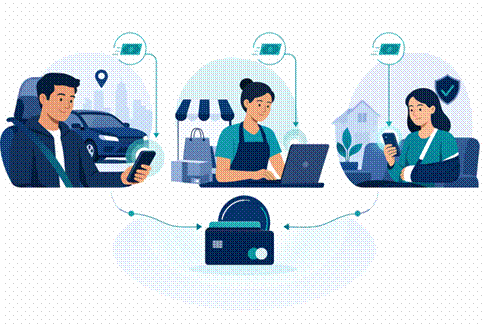
Push-to-card is most valuable in payout moments where speed noticeably improves the recipient's experience: think refunds, gig and marketplace earnings, and insurance claims.
Where it pays off
- Refunds and goodwill payments: A quick credit can help turn a poor service experience around. Mastercard found that 91% of consumers were satisfied as soon as they received a digital credit. One airline also reported a 270% increase in customer satisfaction while cutting compensation costs in half after making greater use of instant credits.
- Gig, creator, and earned-wage payouts: When Uber gave drivers the option to cash out instantly to their debit cards, more than $5 billion was paid out and card use increased by 20%. By 2026, faster access to earnings is becoming an expectation: nearly four in 10 people who depend on disbursements as core income choose to be paid within a day, and most gig workers say they would favour a platform that offers instant pay.
- Insurance and claim payouts: Receiving claim funds quickly can make a difficult situation a little easier. Fewer than a quarter of insurance payouts arrive instantly today, yet 85% of claimants report a positive experience when they can choose how to receive their money. That difference points to a meaningful opportunity for insurers.
- Marketplace and lender disbursements: Sellers value being paid when a sale is complete, and borrowers value receiving approved funds without an unnecessary delay. A faster payout experience can give both groups one less reason to look elsewhere.
The strategic case for moving now
For senior leaders, the question is no longer whether instant payment is a nice feature. The stronger case is that payout speed can influence the business measures they already track:
- Retention and loyalty: Fast access to funds is increasingly part of the experience people expect. When workers, sellers, or customers regularly wait for their money, they have a practical reason to consider another platform.
- A new revenue opportunity: Some recipients are willing to pay for speed. Nearly a quarter of consumers receiving an insurance payout between $500 and $1,000 said they would accept a fee to receive it instantly. That can make instant delivery an optional, revenue-generating service rather than only an added cost.
- Lower service costs: Every 'Where is my money?' call or email takes time to resolve. Faster payouts can reduce those inquiries, and the connection to satisfaction is clear. 2026 research found that highly satisfied recipients were twice as likely to be in the fast-payment group.
- Canadian readiness: Interest already exists: 49% of Canadians find real-time payments appealing, and 36% say they would switch from their current payment method. The RTR is likely to make those expectations even stronger.
Choosing the right rail
Push-to-card does not need to replace Interac e-Transfer or EFT. It works best as an additional choice, used where the value of speed justifies it. The comparison below shows where each rail tends to fit.
|
|
Push-to-card (Visa Direct / Mastercard Send) |
Interac e-Transfer |
EFT |
|
Speed |
Seconds to ~1 minute, 24/7 |
Near real-time to minutes |
1 to 3 business days |
|
What you need |
Recipient’s card number only |
Email or phone (or Autodeposit) |
Bank account + transit / institution |
|
Best for |
Refunds, gig / earned wage, claims, marketplace payouts |
Digital wallet funding and withdrawals, P2P payments |
Scheduled, bulk, low-urgency runs |
|
Reach |
Billions of Visa & Mastercard cards |
Canadian bank accounts |
Canadian bank accounts |
What to get right from day one
Instant payments move quickly, and once the money is sent, it can be difficult or impossible to recover. That makes strong controls just as important as speed. Here are four essentials to have in place from the start:
- Screen before you send: Complete fraud and identity checks before the payment is released, since there may be no opportunity to recover the funds afterward.
- Set sensible limits: Apply clear limits to payout amounts and frequency, so an error or suspicious activity cannot quickly turn into a larger loss.
- Make retries safe: Build the process so a temporary network issue or retry cannot result in duplicate payments and ensure each payout can be reconciled accurately.
- Give people a choice: Let recipients choose how they receive their money. Offering push-to-card, Interac e-Transfer, and EFT allows people to select the option that works best for them.

How to choose an instant payout provider
Once instant payouts have a place in your payment strategy, the next decision is choosing a provider. The right partner should support the rails your recipients already use, while providing the controls and reporting needed to manage payouts at scale. For gig and marketplace platforms in particular, consider the following before making a decision:
- Settlement speed and availability: Confirm that funds can reach recipients within seconds or about a minute, 24/7 - not only during business hours. It also helps to have push-to-card, Interac e-Transfer, and EFT available together so each payout can use the most suitable rail.
- Reach: The service should connect to the cards and bank accounts recipients already use across Canada, reducing the chance that anyone is left waiting for a cheque.
- Platform integration: A well-documented API, a useful sandbox, webhooks, and straightforward reconciliation can make it much easier to add payouts to existing systems.
- Built-in controls and support: Fraud screening, amount and velocity limits, real-time status updates, and reconciliation-ready data should not have to be created from scratch. A strong provider should also be able to support higher volumes and additional payout types as your needs grow.
The bottom line
Canada's Real-Time Rail will change the country's definition of fast payments when it arrives. Customers, however, are not waiting to raise their expectations. Push-to-card gives businesses a way to offer instant refunds and disbursements now, using rails that already connect to cards in Canadian wallets.
The businesses best positioned for the next few years will not simply be the ones that move quickly after the RTR launches. They will be the ones that begin improving the payout experience now.