

4 min read
For as long as most finance leaders can remember, Canadian money has kept bankers' hours. Payments settled on business days, paused for the weekend, and gave treasury teams a predictable rhythm built around cut-offs.
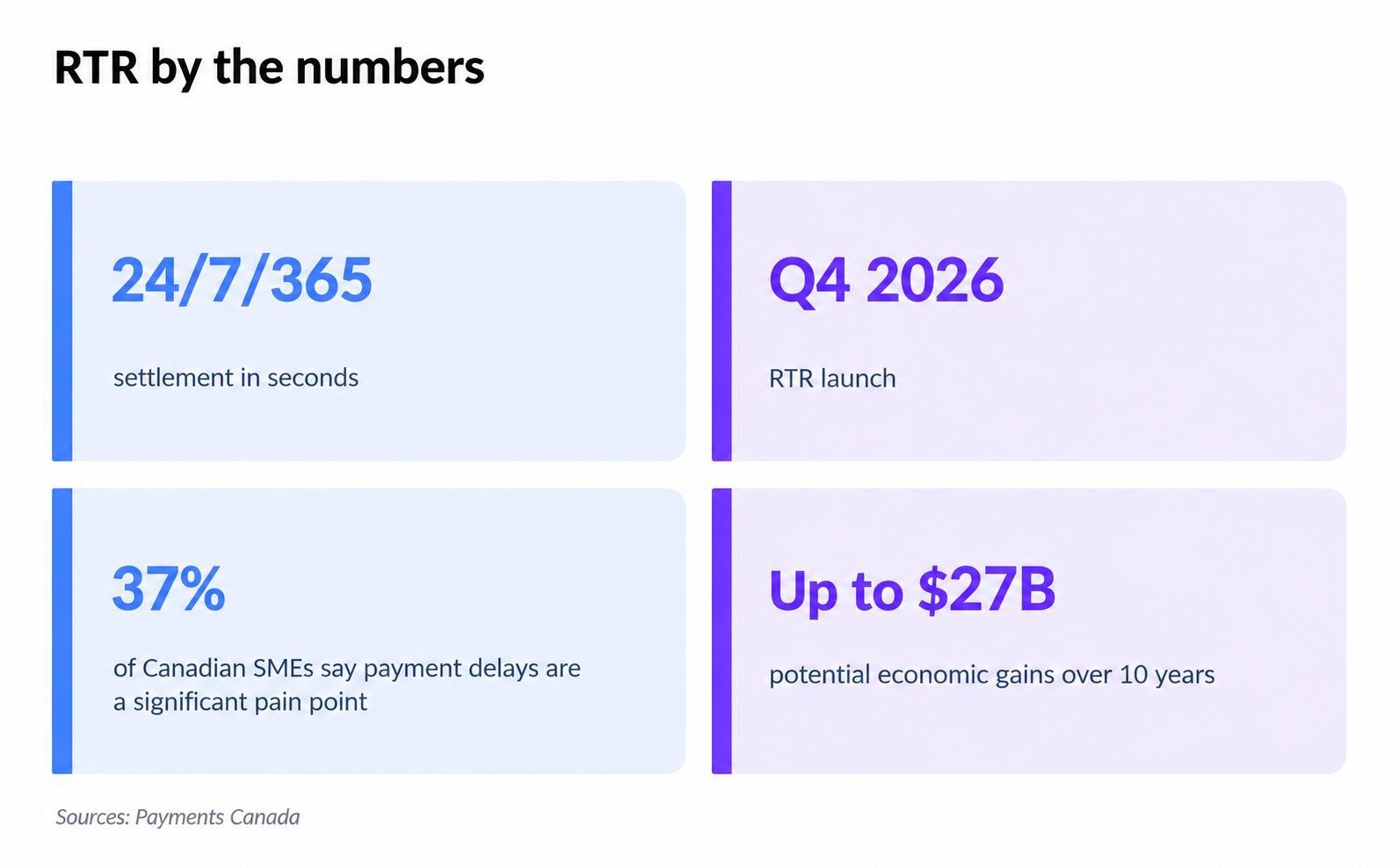
That rhythm is about to change. Payments Canada's Real-Time Rail (RTR) launches in the fourth quarter of 2026, with its by-law and rules in force since August 24. Once it's live, real-time payments in Canada will clear and settle in seconds, 24/7, 365 days a year. This playbook looks behind the scenes, because when money never stops moving, liquidity management can't stop either.
Why Real-Time Payments in Canada Belong on the Executive Agenda Now
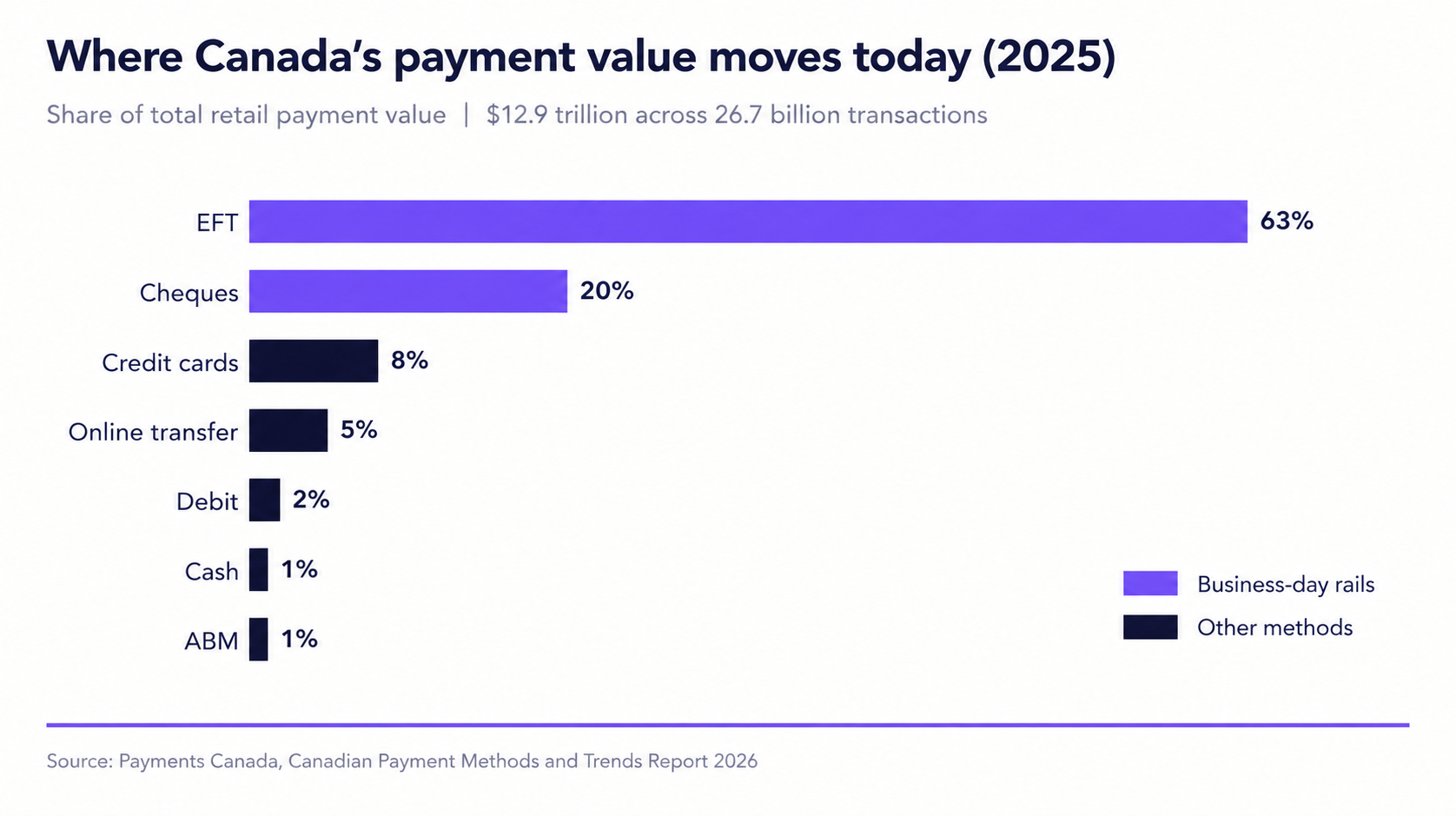
The scale alone makes the case. Canadians made 26.7 billion payments worth $12.9 trillion in 2025, and 83% of that value still moved by EFT and cheque, rails that follow a business-day schedule. As even a slice of that shifts to real-time, today's cash forecasts and buffers will start to drift.
The appetite is already there. Payments Canada's latest business research found that 60% of Canadian businesses are ready to adopt real-time payments to ease cash flow forecasting issues and costly delays, and Payments Canada projects up to $27 billion in economic gains over the next decade resulting from the movement of money flow to the RTR.
The rollout also gives leaders a useful runway. Institutions must receive RTR payments at launch, but sending services phase in, with full participation expected in 2027.
1. What Does 24/7/365 Settlement Change?
In short, it removes the timing cushion treasury teams have always relied on. Batch settlement leaves a lag to catch errors and fund positions, while RTR payments settle in seconds and are generally irrevocable. And because the rail runs through weekends and holidays, a refund on Thanksgiving Monday settles as quickly as one on a Wednesday afternoon.
What doesn't change is just as important. RTR complements, rather than replaces, EFT, Lynx, and Interac e-Transfer®, which Canadians used roughly 1.6 billion times in 2025, as we noted in our mid-year review of the payments trends shaping 2026. Most businesses will run a hybrid model for years, so the goal is to choose the right rail for each flow.
2. Pre-Funding and Buffers: How RTR Affects Liquidity Management
That raises the natural next question: how much cash needs to be ready, and where? Put simply, instant payments need instantly available funds. Direct participants, including payment service providers registered with the Bank of Canada, must pre-fund through Lynx, and even businesses that reach RTR through a partner will feel the effect.
A few strategies are worth considering:
- Size buffers for your weekend, not your weekday. Plan for peak outflows over long weekends like Victoria Day, Canada Day, and Thanksgiving.
- Segment by flow. Separate pools for refunds, payroll, and supplier payments make it easier to see what's committed.
- Set replenishment triggers. Use balance thresholds that prompt a top-up automatically.
- Avoid over-hoarding. The Bank of Canada's 2026 Financial Stability Report notes that Canadian businesses already hold more cash than they did before the pandemic. The aim is the right amount in the right place.
3. Cash Flow Forecasting for Continuous Settlement
Of course, buffers are only as good as the forecasts behind them. Payments Canada describes a Vancouver business owner who can't forecast cash flow because customer payments take days to clear. RTR calls for rolling, intraday forecasts for your fastest-moving flows, modelled by hour and day of the week, while still accounting for fixed Canadian obligations like GST/HST remittances and provincial statutory holidays.
The good news is that RTR helps solve the problem it creates. Built on the ISO 20022 standard, it carries richer payment data straight into ERP systems, the same principle behind request-to-pay flows ahead of RTR.

Real-time visibility turns after-hours cash movement from a blind spot into a dashboard.
4. How Should Approval Policies Change for 24/7 Payments?
With forecasting in place, attention turns to the rules. Approvals need to move from manual, business-hours sign-offs to pre-set limits that work at any hour, with people stepping in for the exceptions.
- Cut-offs: Decide which flows truly need 24/7 settlement.
- Limits: RTR launches with a $100,000 transaction limit (compared with $25,000 for business Interac e-Transfer®), and providers can set lower caps, so align your per-transaction and daily limits with your risk appetite.
- Vendor and tax timing: Payments Canada cites a Halifax manufacturer that missed a 2% supplier discount by six hours. Instant settlement lets you capture discounts and pay suppliers or the Canada Revenue Agency on the due date, not days early.
Fraud controls belong here too. RTR launches with centralized fraud services from day one, including confirmation of payee, but these complement your own controls rather than replace them.
5. Connectivity, Alerts, and a Phased Plan
Nobody wants a treasury team on call all weekend. Real-time balance monitoring, threshold alerts, and automated reconciliation let teams respond to what matters without watching screens.
From there, readiness works best in phases that mirror the rail's own rollout:
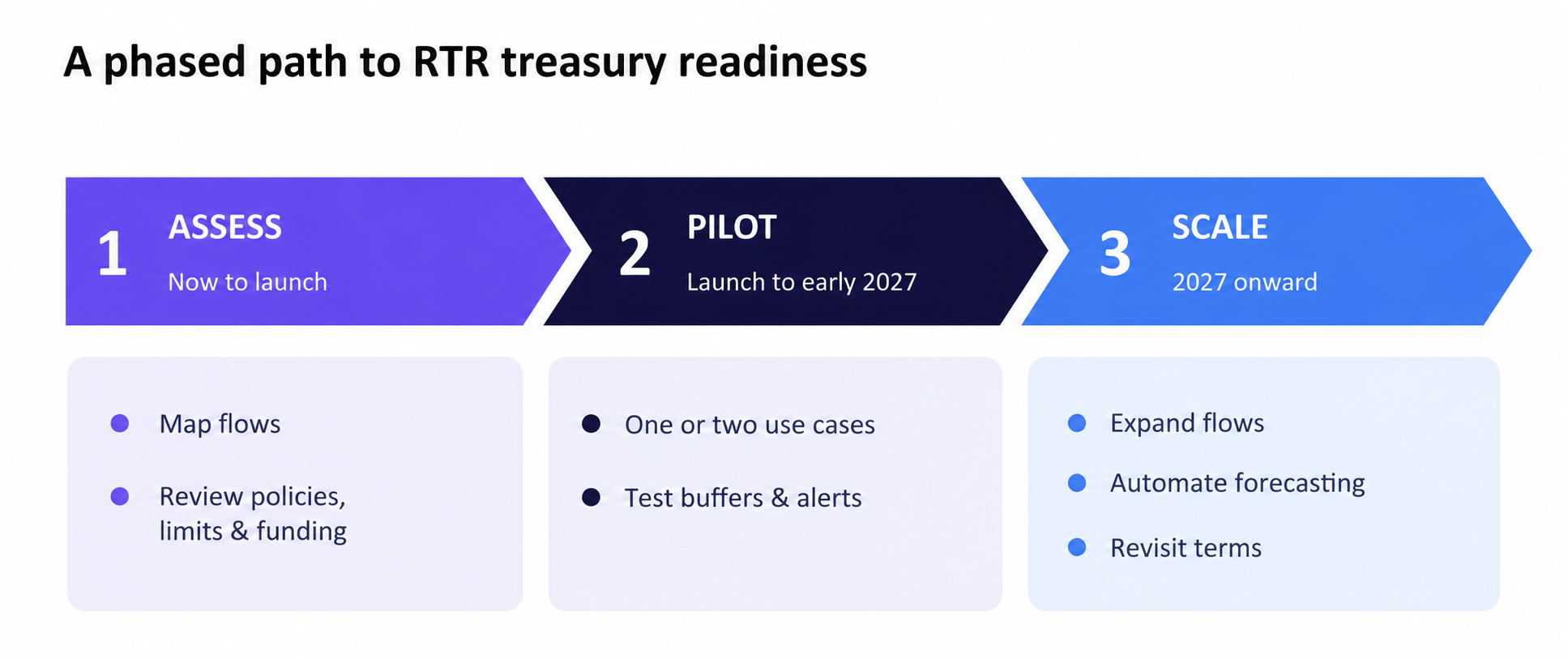
- Assess (now to launch): Map payment flows and review policies, limits, and funding.
- Pilot (launch to early 2027): Start with one or two use cases, such as refunds or contractor payouts.
- Scale (2027 onward): Expand to more flows as Interac e-Transfer® volumes move onto the Real-Time Rail and full participation arrives.
Where DCPayments Fits
Getting ready for RTR doesn't mean waiting for it. DCPayments gives Canadian businesses access to Interac e-Transfer®, EFT, Visa Direct®, and Mastercard Send® through a single integrated platform or via API connectivity. Our Direct Deposit Tracking (DDT) technology automates reconciliation with 24/7/365 reporting, giving finance teams the visibility that accurate cash flow forecasting demands. If faster disbursements are on your roadmap, our guide to real-time refunds and disbursements with Visa Direct and Mastercard Send is a natural next read.
Ready for Always-On Money?
Real-time payments in Canada will reshape what customers and suppliers expect, and the businesses that benefit most will be the ones whose treasury operations are ready first. Now is the time to stress-test buffers, modernize forecasts, and update the policies that will govern money that never sleeps.
Schedule a treasury readiness session for RTR with our team. We'd be glad to walk through where your payment flows stand today and what it will take to move confidently into a 24/7 world.
Further Reading
- The Future of Payments in Canada: Inside the Launch of the Real-Time Rail
- Request-to-Pay in Canada: How to Design Your First RtP Flows Ahead of RTR
- Instant Payouts in Canada: Designing Real-Time Refunds and Disbursements with Visa Direct and Mastercard Send
- The Way We Pay: A Mid-Year Review of the Payments Trends Shaping 2026
Frequently Asked Questions
How does RTR affect liquidity management?
RTR payments settle in seconds, around the clock, and are generally irrevocable, so funds must be available at all hours. Liquidity management shifts from a daily routine to continuous monitoring, with buffers sized for after-hours peaks.
What pre-funding strategies should businesses consider?
Size buffers for weekend and holiday peaks, segment funding by flow, and set automatic replenishment thresholds. Direct RTR participants must also pre-fund through Lynx.
How should approval policies change for 24/7 payments?
Replace business-hours sign-offs with pre-approved limits and rules-based approvals for routine payments, keeping human review for exceptions and high-value transactions.