

6 min read
Britain didn't decide that same-day payouts would become standard. Customers decided, and everyone else caught up. Canada's Real-Time Rail arrives in the fourth quarter of 2026, which makes the UK's story more useful right now than any forecast.
.png?width=1536&height=1024&name=Designer%20(31).png)
Split a dinner bill in London, and the money is there before you've found your coat. Invoice a client in the morning, and the payment often clears by mid-afternoon. Waiting for money feels faintly old-fashioned there now. None of that is because British customers are more impatient than Canadian ones. A rail went live, businesses built things on top of it, and within a few years everyone's expectations had moved.
Canada is about to run the same experiment. The Real-Time Rail is due late this year, and June's draft regulations put consumer-driven banking on a similar clock. Two separate tracks, one from Payments Canada and one from the Department of Finance, are landing at roughly the same moment.
So, the interesting question isn't what the RTR will do. It's what happened in Britain after its version went live, and which of those consequences are worth getting ahead of.
Why the UK promised speed, not a feature
The UK's Faster Payments system launched in 2008, almost two decades ago! Its initial purpose was to fix a three-day bank transfer. For years it grew quietly, and nobody wrote much about it. The interesting part came later, once businesses stopped treating it as a faster version of an old process and started building products on it. Last year it carried 5.55 billion payments, up from 1.66 billion in 2017, and moved £1.27 trillion in the final quarter alone.
The curve matters more than the totals. Volume has gone up every single year since 2017, through lockdowns and a cost-of-living squeeze, and the new traffic isn't cash and cheques disappearing. It's payroll, platform payouts and pay-by-bank checkout. Businesses moved that volume on purpose, because speed changed the math.
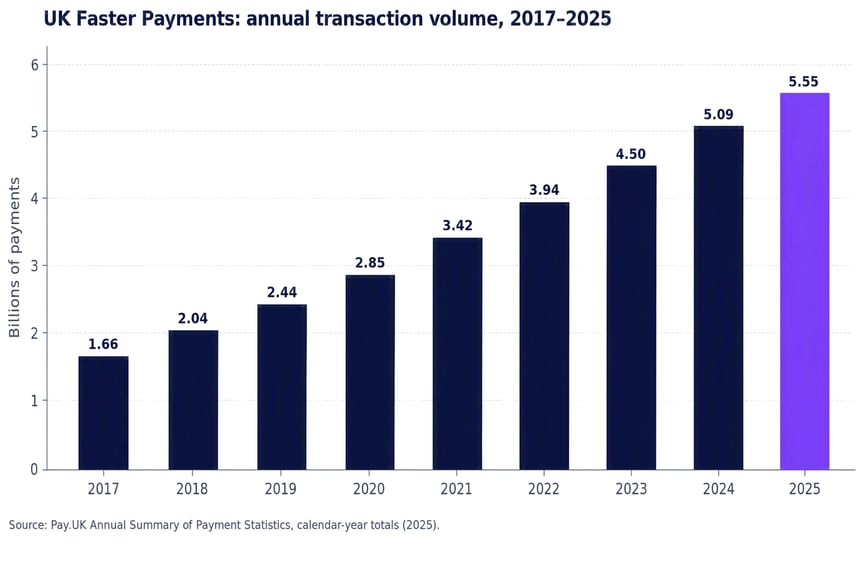
UK Faster Payments have more than tripled since 2017, adding roughly half a billion payments in 2025 alone. Source: Pay.UK Annual Summary of Payment Statistics.
That's the part worth sitting with. The rail didn't create the demand. Demand showed up when a company rebuilt a customer moment around instant money, and customers noticed.
Where instant payments in Canada stand today
Canada starts from a better place than Britain did in 2008. Interac e-Transfer® already moves consumer money in near real time, and Interac Request Money gives businesses a working request-to-pay option for receivables. DCPayments has further developed the Interac Request Money technology to allow it be used at an online point of sale checkout. Visa Direct and Mastercard Send can already push instant refunds and disbursements to a card in seconds. The RTR will be connected to all of it as an always-on clearing and settlement layer, carrying ISO 20022 messaging so that remittance details travel with the payment. Together, those rails already cover most of what account-to-account payments do in other markets.
The regulatory side is moving at the same time. Open banking in Canada, formally consumer-driven banking, came through Budget 2025 and the draft regulations of June 27, 2026, with the Bank of Canada as lead regulator and data access first. For fintechs, that's less a policy date than an infrastructure one: accreditation, secure data access and the API work behind them must exist before any commercial use case does. Britain shows what happens when both pieces land. There were 351 million open banking payments in 2025, up 57% in a year, across 16.5 million active connections. Canada is about where the UK was just before that curve bent upward.
Five lessons worth importing
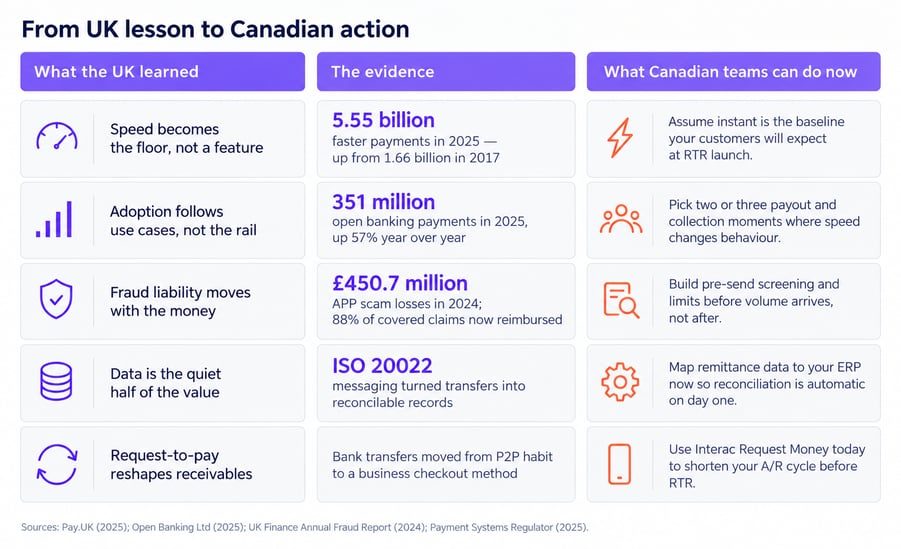
Five lessons from the UK, and what each one asks of a Canadian team.
1. Speed becomes the floor, and the floor is a promise: Instant transfer went from selling point to assumption in about five years. What matters is what happens after that: speed stops being something you can charge for and becomes something you can only get wrong. In banking, a fast transfer is a convenience. In consumer markets it's a promise, and people punish a broken promise far more than they reward a kept one. Treat RTR readiness as a 2027 IT project, and you'll be selling to customers whose bank, payroll provider and favorite marketplace have already taught them to expect the money today.
2. Adoption follows use cases, not infrastructure: Volume climbed when journeys got rebuilt: gig payouts, instant refunds, supplier settlement, eventually checkout. Nobody moved everything at once. Pick the two or three moments where waiting visibly costs you, the refund that triggers a support call, the seller who quietly leaves, and starts there. Two well-chosen journeys will teach you more than a year of planning across twenty.
3. Fraud liability moves with the money: Instant means irrevocable, and Britain shows where that pressure lands. APP scams took £450.7 million from UK consumers and businesses in 2024. Since October 7, 2024, reimbursement has been mandatory for most covered scams, capped at £85,000 a claim and split down the middle between the sending and the receiving firm. In the first year, 88% of covered claims came back. Canada hasn't copied that regime, but the direction is clear enough that it's worth building controls as though it will.
4. Data is the quiet half of the value: The finance benefit isn't the speed. It's that structured remittance data turns up with the money. ISO 20022 on the RTR means a payment can carry the invoice reference that lets a system match it without a human. That's where real-time payments and payment automation meet: matching, posting, and exception handling that someone does by hand today become rules software runs. It's a reconciliation and working-capital story, and the ERP mapping usually takes longer than the payment integration.
5. Request-to-pay reshapes receivables, not only payouts: Most coverage is about sending money faster. In the UK, the bigger commercial shift happened on the collection side, as the bank transfer went from something you did with friends to a way to pay for a business, with no card interchange attached. Canadian firms can rehearse that now with Interac Request Money and reach RTR launch with receivables already built for it.
Where the new standard gets set first
One detail is easy to miss: this didn't start in corporate treasury. It started in high-turnover consumer businesses. Challenger banks, gig platforms, marketplaces, online entertainment, where customers are mobile-first, impatient and one tap from a competitor. Those firms couldn't live with settlement times a finance department shrugs at, so they leaned on their payment partners, and the improvements spread outward from there.
Canada has the same proving grounds: gaming and lottery disbursements, gig and creator payouts, insurance claims, marketplace settlement. If you're in one of them, you'll feel the shift first and have the least room to wait. If you're not, watch them anyway. Instant refunds and live balances were consumer conveniences long before they were board topics, and that order tends to repeat.
The strategic case for moving before launch day
The case for moving now isn't that technology is interesting. It's that the transaction has become part of the product. People judge you on the settlement moment, the few seconds between asking and seeing it, and that judgment shows up in numbers already on your scorecard.
- Cash in transit is cash you can't use. Take a day out of settlement and your working-capital position changes.
- Fewer people call to ask where their money is.
- Sellers, workers and claimants stay where they can choose to be paid now instead of waiting for a batch run.
- On the transactions where account-to-account payments genuinely compete with a card, acceptance costs fall.
None of that waits on the RTR. It waits on a decision to rebuild a handful of payment moments, and on having fraud checks, limits and reconciliation sorted before the volume shows up.
What to get right on an irrevocable rail
Speed removes the window where mistakes normally get caught. Screening and identity checks must happen before the money leaves, because afterwards there may be nothing to recover. Limits on amount and frequency keep a mistake or a compromised account from turning into a very bad afternoon. Retry logic must be built so a dropped connection doesn't pay someone twice. The same discipline applies to embedded payments, where the money moves inside someone else's product, and the controls are easiest to overlook.
Two things stand out in the UK data. The money lands at receiving institutions: smaller payment firms took in 34% of scam value while handling 19% of consumer Faster Payments, which makes your counterparties a real diligence question. And invoice and mandate fraud, £42.7 million of UK losses in 2024, goes after the accounts-payable process rather than technology. Dual approval and verified supplier details beat a better gateway every time.
A three-phase roadmap for the next four quarters
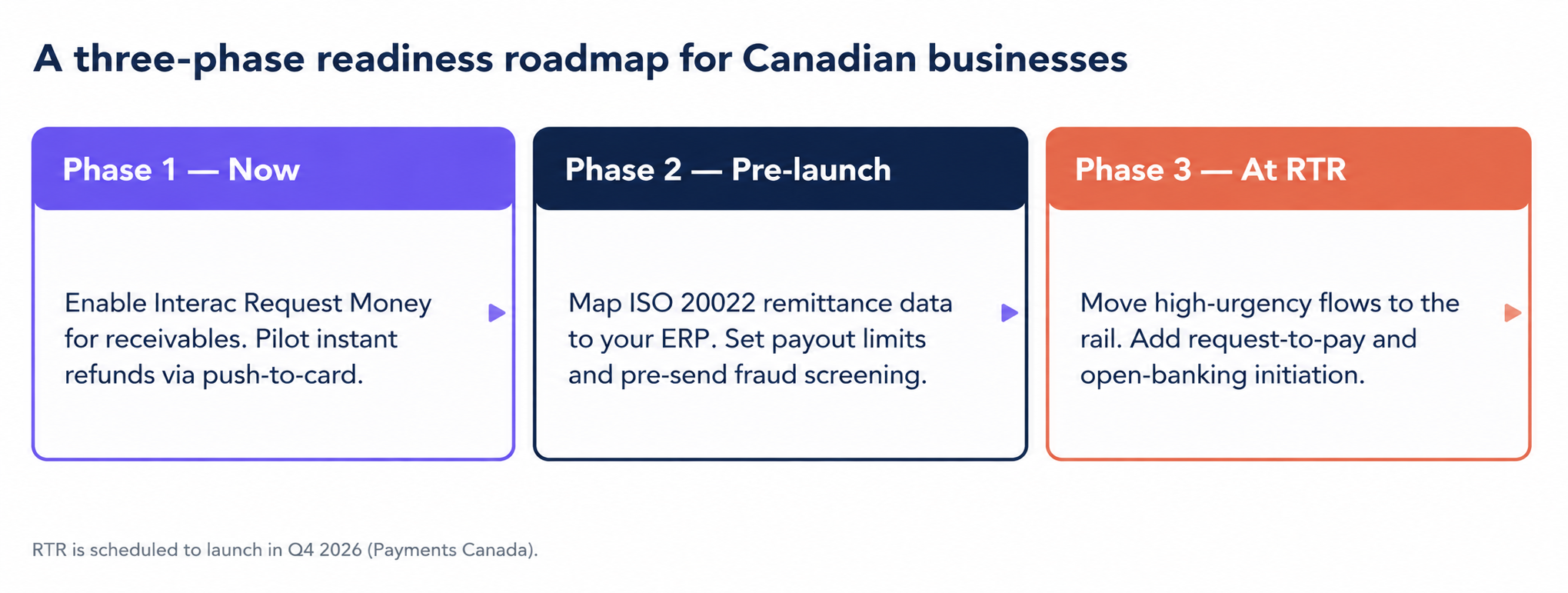
Most of the value is available before the rail is live. RTR launches in Q4 2026.
Sequence beats ambition here. Phase one runs on rails you already have, so the business case gets proven on real customers before anyone funds RTR work. Phase two is the dull part: data mapping, limits and screening, and it's the one that gets left too late. Phase three is small if the first two were done properly.
The bottom line
The UK lesson isn't that instant payments are popular. It's that the floor moved faster than most businesses planned for, and the winners were the ones who had already rebuilt a few customer moments while everyone else was still discussing it.
Canada has about a year, and rails that already work. The RTR raises the ceiling. The businesses that use it best will be the ones that made same-day payouts unremarkable before the launch date arrived.
Thinking about where to start? DCPayments works with Canadian businesses on instant payouts, request-to-pay and reconciliation across Interac, EFT, Visa Direct and Mastercard Send. Book a session and we'll map the first two use cases with you.