

6 min read
5 min read | Real-Time Rail (RTR) Fraud Prevention · Real Time Payments · Compliance
For most of the history of Canadian payments, particularly larger ones, there was a gap between hitting "send" and the money arriving. Nobody designed it as a fraud control, but it often worked like one. A suspicious transfer could be flagged in the overnight batch, and the funds could usually be recovered before the customer lost anything.
Canada's Real-Time Rail (RTR) closes that gap. Payments Canada switched it on November 9, 2026, and payments on it now clear and settle in seconds, at any hour, on any day, up to $100,000. Settlement is final and can't be reversed. A fraud decision must happen before the money leaves, and it usually has less than a second to do it.
Canada went into this with its eyes open. Payments Canada says it's the first G7 country to deploy a real-time payment system with mandatory centralized fraud services at launch. Those services sit alongside each participant's own fraud controls, though. They weren't built to replace them, and that detail tends to get lost in the launch headlines. For leadership teams, the useful question is how much of the load your own fraud prevention is ready to carry.
Why Fraud Readiness Belongs on the Executive Agenda Now
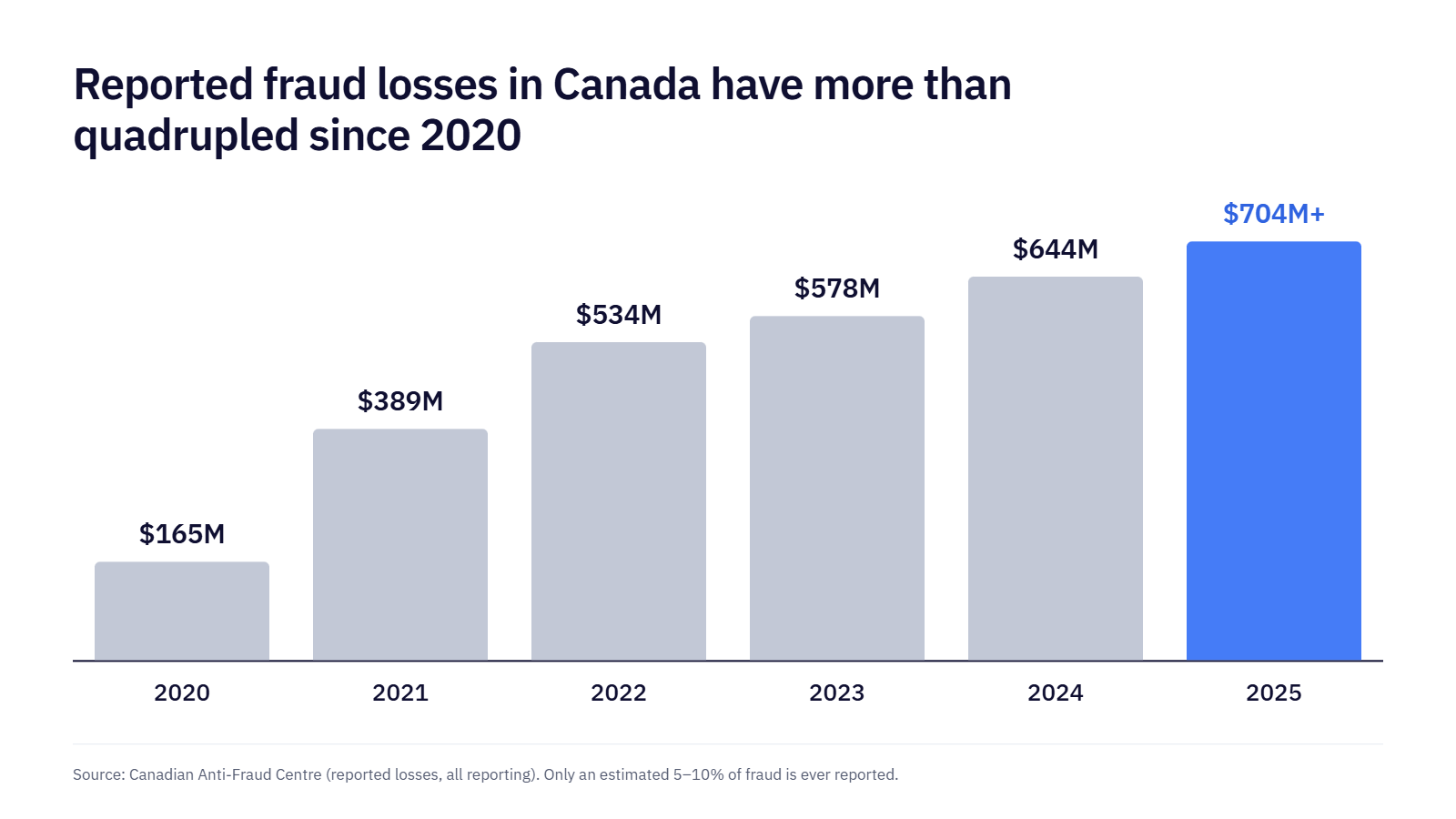
Start with the scale of the problem. Figures from the Canadian Anti-Fraud Centre (CAFC) show Canadians reported more than $704 million in fraud losses in 2025, compared with $165 million in 2020. The CAFC also estimates that only 5% to 10% of fraud is ever reported, so the real number is a good deal larger.
Where the money went is just as telling. Investment scams led 2025 at $351 million, followed by romance scams at $63.3 million and job scams at $50.6 million. In most of those cases, nobody broke into an account. The victim was talked into sending the money.
Payments like that are exactly what criminals will look for on an instant, irrevocable rail. Timing matters here, too. Payments Canada expects the RTR to reach more than nine in ten Canadians within its first year, and Budget 2026 committed to a legislated Multi-Sector Anti-Fraud Framework. Fraud on the new rail will show up in customer trust and in conversations with regulators, and it will limit how fast you can responsibly grow RTR volume.
A Preview from the UK: Criminals Follow the Easiest Path
The UK has had instant payments since 2008, which makes it a good place to see how payment fraud shifts once speed becomes normal. In 2025, UK Finance reported that unauthorized fraud, such as stolen card details, fell 5% to £703.4 million, with the industry stopping roughly 70p of every £1 of attempted unauthorized fraud. Authorized push payment (APP) fraud went the other way, up 19% to £576.4 million.
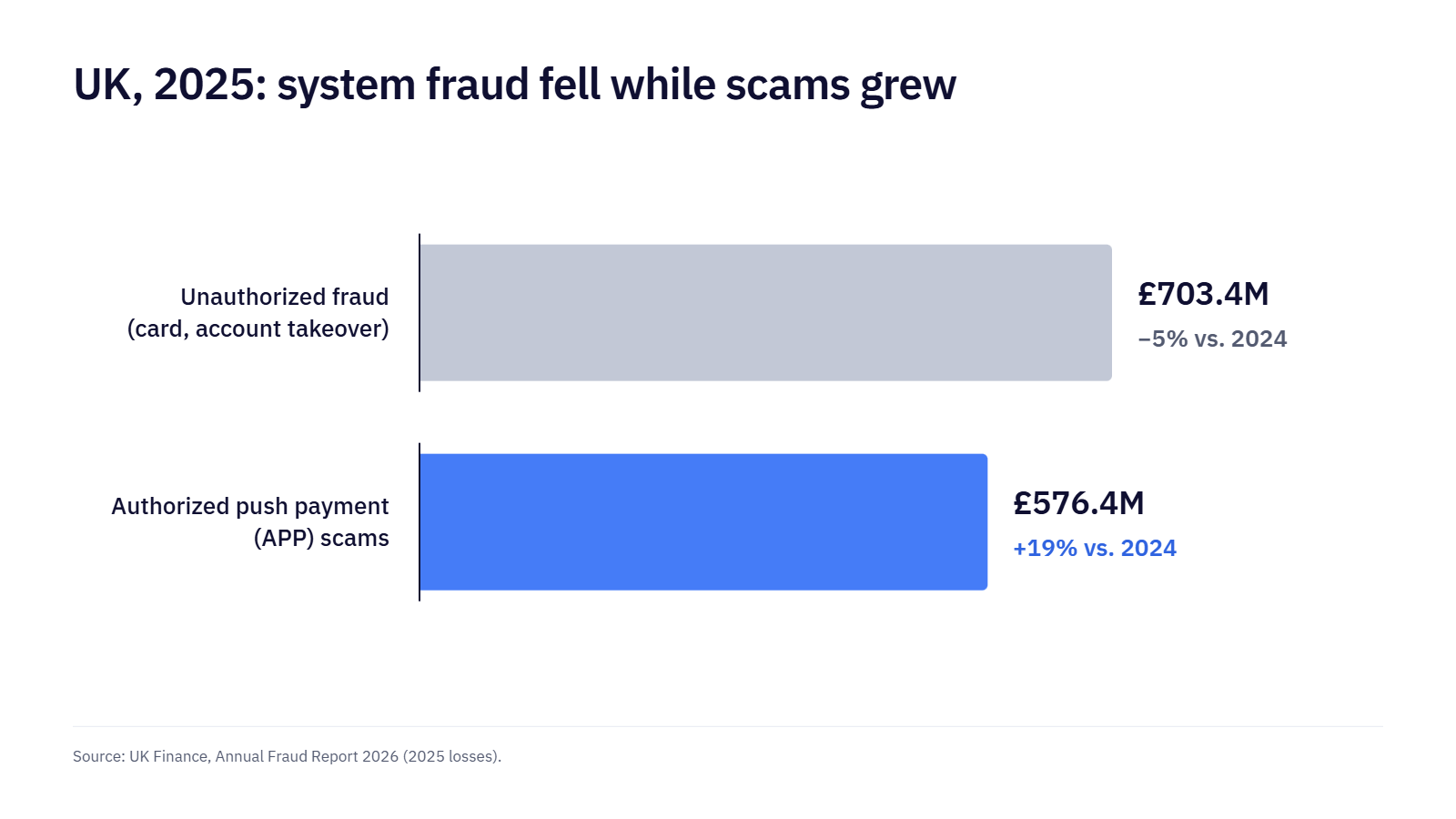
As banks got better at stopping stolen-card and account-takeover fraud, criminals turned their attention to customers instead. Reimbursement helps victims, but it doesn't stop the money from moving: UK banks paid back £354.3 million in APP losses in 2025, and all of it had already reached criminals. Stopping the payment before it's released is what reduces harm, and it's one more lesson Canada can take from the UK's real-time payments journey.
What the Real-Time Rail's Central Fraud Services Do, and What They Don't
So, what does Canada's Real-Time Rail provide? At launch, it comes with four centralized fraud services:
- Confirmation of payee, which lets a sender check the recipient's account identity before they hit send (available for consumer accounts on day one).
- A fraud transaction "safety" score that assigns a real-time risk score to every transaction before it's authorized.
- A shared risk list that flags accounts previously linked to confirmed fraud.
- A fraud reporting and intelligence platform that pools data on fraud trends across the whole RTR ecosystem.
That's a solid foundation. A central service, however, only sees the payment. It doesn't know your customer has been on the phone for forty minutes, logged in from a device you've never seen, or is about to send ten times their usual amount to a stranger. You have that context, and nobody else on the network does.
The confirmation of payee has a blind spot, too. It's very good at catching a payment headed to the wrong name. In many scams, though, the victim pays a real account in the right name, opened or rented by a money mule. The check passes and the money is gone anyway.
Building Your Layer: Sub-Second Controls That Work Together
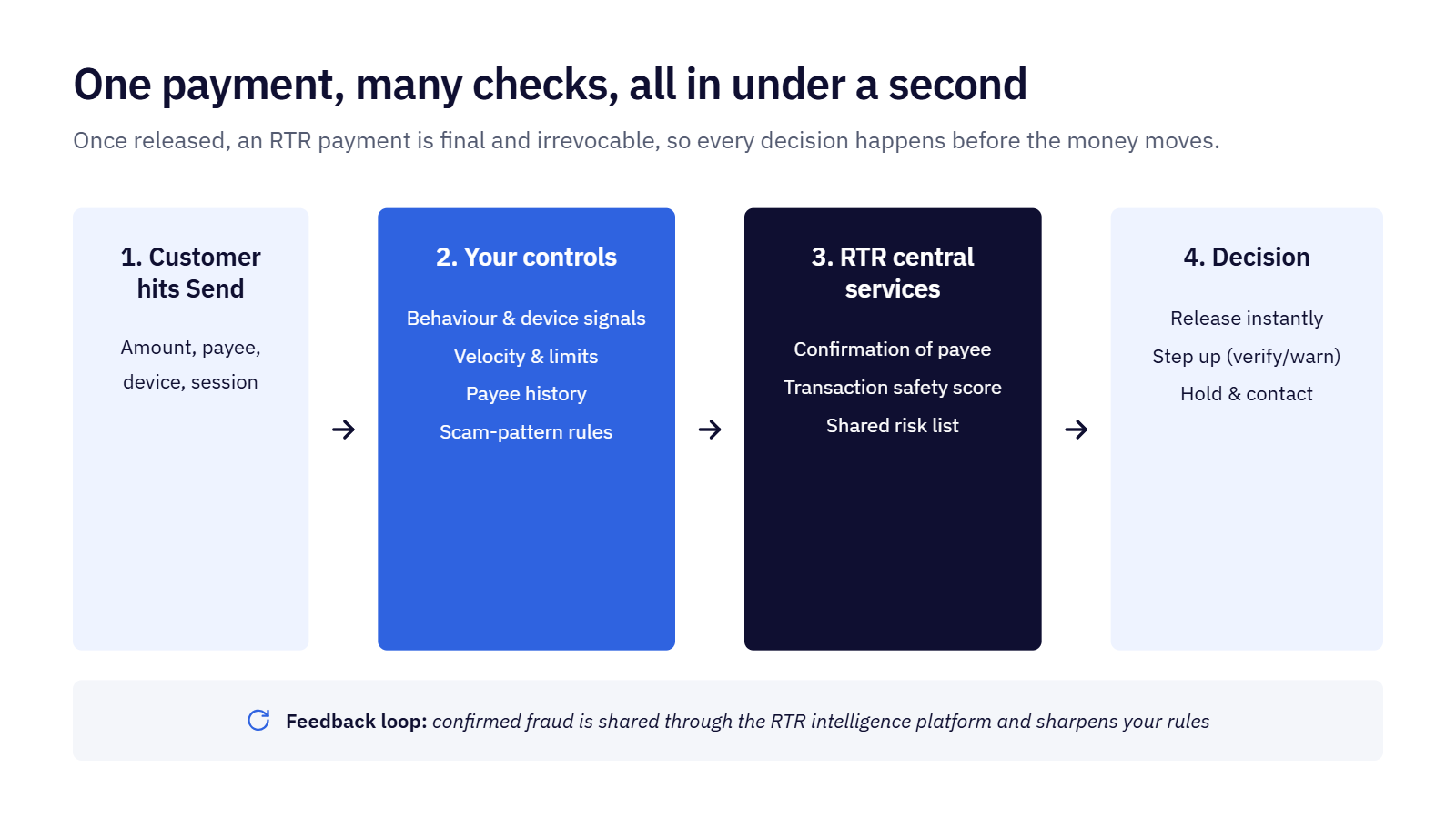
What should payment fraud prevention look like on your side of the rail? Most teams don't need more checks so much as a better way to combine the ones they have. Your signals and the RTR's should feed one fast decision, made before the payment is released.
Know what "normal" looks like for each customer
In any real-time fraud detection setup, behavioral and device signals give you the earliest warning. A new phone, a login from an unexpected place or remote-access software running in the background can mean the customer is being coached by someone, or that it isn't the customer at all.
Put sensible guardrails on speed and volume
Velocity checks track how much money is moving, how fast and to whom. Lower limits for first-time payees, plus a short cooling-off period after someone adds a new payee, can break up the familiar pattern of several quick transfers that empty an account. Regular bill payments and transfers carry on as normal.
Treat the recipient as a risk signal, too
Take the confirmation of the payee result and any risk list match, then add what you know about the recipient. Has this customer ever paid them before? Does the account look like a mule account, with money landing from lots of sources and leaving almost straight away? Watching inbound flows also keeps you from hosting mule accounts without realizing it. When we wrote about the security gap in embedded payments, we noted that risk tends to collect where systems meet. The receiving end of a payment is one of those places.
Bring it together into one decision
From there, real-time fraud detection should combine the RTR safety score with your own risk score and settle on one of three outcomes: release the payment, step up with an extra check or warning, or hold it and contact the customer. Feed every confirmed case back into your rules and into the RTR's shared intelligence. The more that goes back in, the faster everyone on the network spots the next scam.
Playbooks for the Scams That Matter Most
Two examples show how the layers handle authorized push payment fraud, where the customer is persuaded to send the money themselves. The first is a Calgary contractor who gets an email from a "supplier" with new banking details a few days before a large invoice is due. When the payment is set up, confirmation of payee flags a name mismatch, and that's the cue to pick up the phone and check.
The second is a retiree caught in a bank investigator scam. A caller claiming to be from the bank's security team is pushing them to move their savings to a "safe account." This time the payee name matches, because the mule account is real. What doesn't fit is everything else: a payee they've never paid, an amount far above normal, and a phone call in progress while the payment is set up. Your controls hold the payment, and someone from the bank calls the customer back. In neither case would one signal on its own have been enough.
Adding Friction Only Where It Earns Its Keep
None of this helps if it ruins the instant experience customers signed up for. Strong defences against payment fraud should be invisible for most people. Most payments should go straight through, and only a small, higher-risk group should get a second look.
When you do step in, be specific. People click straight past a generic "Are you sure?" A message like "Your bank will never ask you to move money to keep it safe" speaks to the scam they may be in the middle of. Keep an eye on the other side of the ledger as well. False declines and abandoned payments cost you revenue, and sometimes the customer.
Where DCPayments Fits
Good payment fraud prevention depends on what sits underneath it. DCPayments' API-first platform gives you direct access to payment data and controls through API, online portal or SFTP. Your team can try out step-up flows and decision logic in our sandbox before customers ever see them, and our Compliance-as-a-Service platform handles real-time transaction monitoring, automated screening and FINTRAC reporting.
Money can now move across Canada in seconds, and fraud prevention must keep the same pace. With the Real-Time Rail live and more participants joining in the coming months, now is a good time to test your controls against the scams you're most likely to face. Our team will walk through your payment flows with you and help find the gaps before fraudsters do.
Book a threat-modelling session before you go live on the RTR
Frequently Asked Questions
Does Canada's Real-Time Rail include centralized fraud protection?
Yes. The RTR launched with mandatory centralized fraud services, including confirmation of payee, a transaction safety score, a shared risk list and a fraud intelligence platform. They're designed to be used alongside each participant's own fraud controls.
What checks should run before an RTR payment is released?
At a minimum: customer behavior and device signals, velocity and limit checks, a recipient risk review (including confirmation of payee and risk list results) and a combined risk score that decides whether to release, step up or hold the payment.
How do you balance fraud prevention and speed on real-time payments?
Let automation clear low-risk payments instantly and save the extra steps for the small share that looks risky. A warning written for a specific scam protects customers far better than friction applied to everyone.
Further Reading